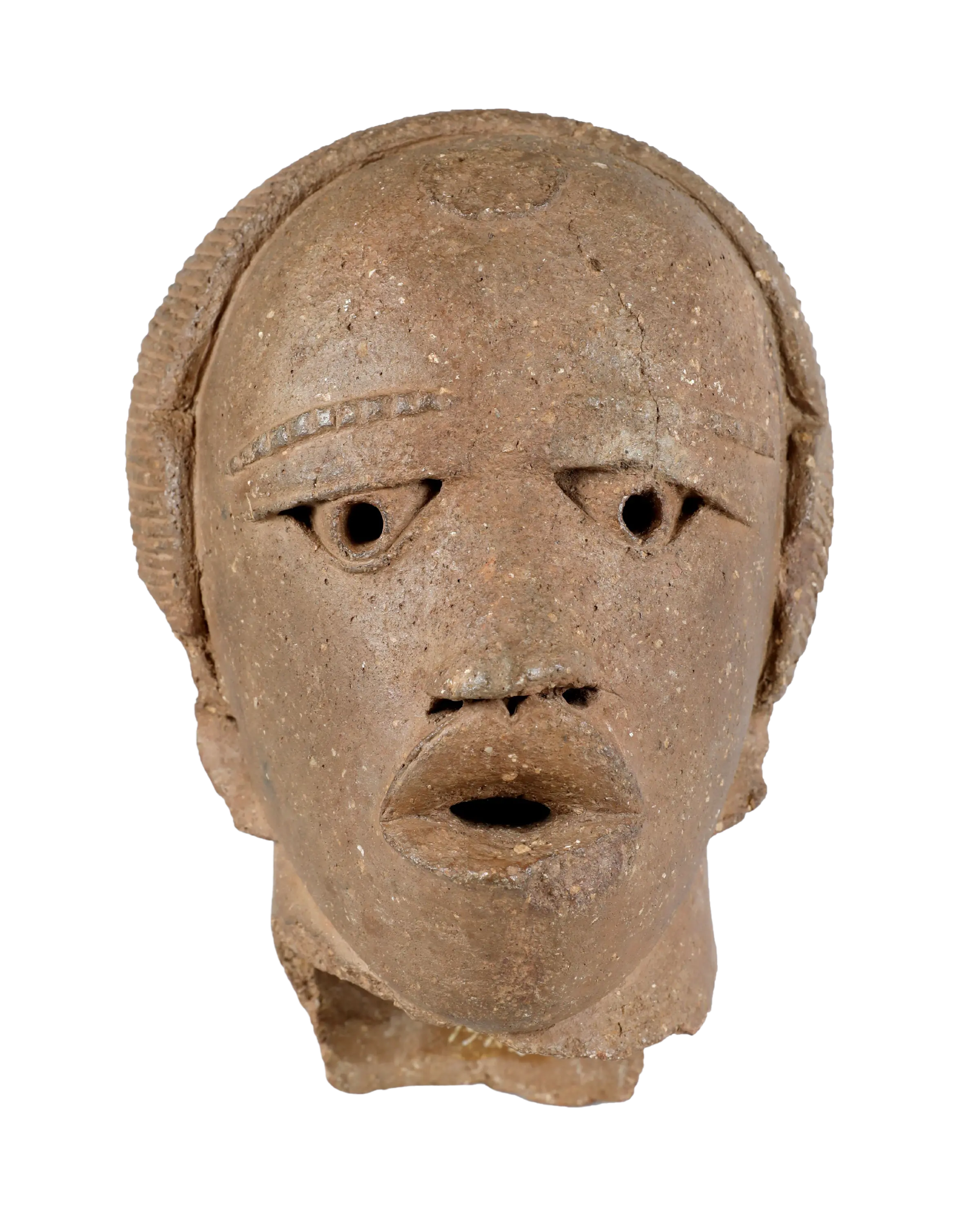
About three thousand years old, this remarkable representation of a human head is not only a testament to ancient artistry but also a key marker in the birth of figurative sculpture. Its discovery was purely accidental: unearthed in 1943 at the Tsauni mine in Jemaa, it fell into the hands of a miner who, captivated yet unaware of its significance, used it as a scarecrow. Remarkably, despite years of exposure to rain and sun, it sustained little damage — a silent witness to the exceptional craftsmanship and enduring quality of its creation. The slightly open mouth, as if exhaling a breath, the piercing gaze and the intricate adornments — including forehead jewellery in the shape of a ring and the finely detailed coiffure — imbue the figure with an almost haunting lifelike presence. What stories might this enigmatic relic hold?
Nok Head
Nok village, in Kaduna State, is at the centre of the “Nok culture” region. Bernard Fagg, in 1943, was the first researcher to identify the ancient culture and name it as such after the village, where the first works were identified. Fagg defined the wider region from two isolated sites in the northwest (Kagara) and southeast (Katsina Ala). Excavations by the Frankfurt Nok Research Project in the last decade have refined Fagg’s estimated geographical region, and chronology, pushing it back to the beginning of 1st millennium BCE. They have also demonstrated complex ritual structures among the Nok peoples.
Map showing the location of archaeological sites discovered by Bernard Fagg and others during the 20th century (blue dots) and by the Frankfurt project between 2005 and 2008 (red dots) as well as the presumed expanse of the Nok Culture according to site distribution determined by researchers in the last century (after Fagg 1977). The outlined rectangle in the centre indicates the project’s key study area, where investigations have been carried out since 2009